Diagnosis
Something is off.Two weeks, then you know.
For companies that want the problem named before they act on it.
The case
Most leadership teams can feel friction below them long before they can describe it. Delivery is slower than it should be, decisions bounce, and the explanations don't quite add up.
This is a read from outside the reporting lines, by someone with nothing at stake in which explanation turns out to be right. Sometimes it confirms what you suspected. Sometimes the friction everyone points at is a symptom of something structural nobody named.
The problem
There is no fixing what hasn'tbeen correctly named.
Frame
What you already suspect, what prompted this, and what a useful answer would look like.
Observe
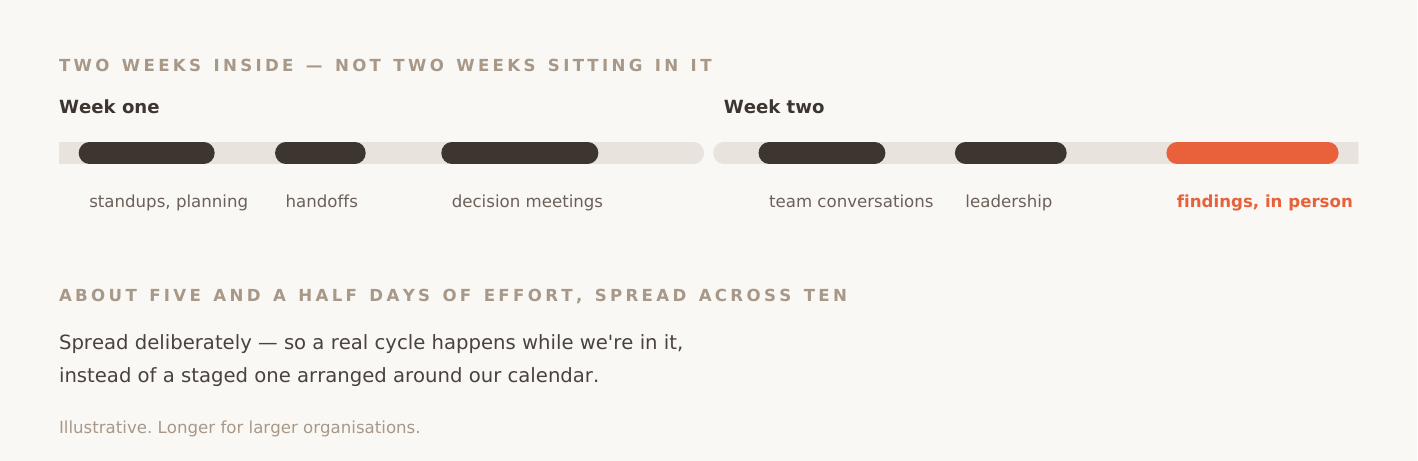
Inside real delivery: the meetings, the decisions, the handoffs. Plus conversations at team and leadership level.
Analyse
Separating symptom from cause, and testing whether the internal explanation holds up.
Hand over
Findings and priorities delivered in person, with the reasoning open to challenge.
At a glance
- What it is
- An independent assessment of how the organisation delivers and how it is led
- Examines
- Processes and delivery · Team and leadership
- Does not cover
- Commercial performance, market position, technology assessment
- Duration
- Two weeks minimum, longer for larger organisations
- You receive
- Findings document · Recommendations and priorities
Price
€5,000up to 80 people
€6,50081–150 people
Excludes VAT and travel expenses.
Where €5,000 sits
Your main options for a diagnosis in the market:
A culture survey. Your people fill in a questionnaire, and software sends you a report. Nobody from the survey company ever sees your business. Under €1,600.
Another consultancy. They send a team to scheduled meetings, and their final presentation ends with a proposal for more work. From €6,500.
Our Diagnosis. One senior person from BoloDeCoco spends about two weeks inside your everyday business, listening to people and looking in the dusty corners and under the carpets. It ends with you knowing what to do. In most cases, without us.
Cultiv8tiv pricing · BDU Honorare im Consulting 2025 · accessed September 2026
Acting on it
Most companies act on this themselves. That's the expected outcome. The recommendations are written to be actionable by your own people, not to require us. Where continuing makes sense, we'll say so and explain why. Where it doesn't, we'll say that too, including when the right next step is someone else.
A second opinion that always reaches the same conclusion isn't a second opinion.
What we need
- 01
Diagnosis before definition — we scope after we've seen the situation, not before.
- 02
Change needs backing, not awareness — whoever holds the authority has to be engaged as the main enabler. Without that backing there is little we can do.
- 03
Principles before methods — no frameworks adopted for their own sake.
- 04
Say the thing — honest communication throughout, in both directions, including what most organisations avoid saying.
- 05
Short cycles, real feedback — continuous improvement embedded, no vanity metrics.
Start a conversation.
No deck, no theatre. Just a sharp look at what is actually getting in your way.