
Structure & Setup
Your strategy is a rumour.Everyone's heard a version.
Half the work is figuring out what the work is. Structure & Setup checks whether the business model and the internal strategy are actually set. Then puts them in the room, tests them against the people who'll live with them, and helps it land.
Ten people. Which way is forward?
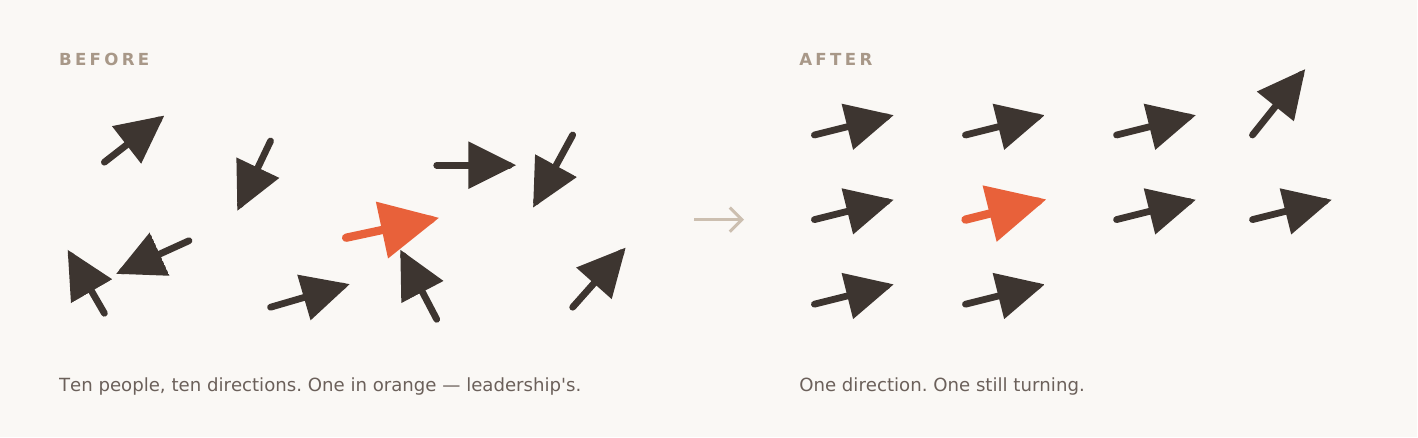
Everyone knows what a room of arrows pointing everywhere means, and what it looks like when they don't. One is still off: honest re-check isn't a perfect grid.
The offer
Twenty weeks. Four phases.Fixed price, fixed end.
Set
weeks 1–5
Honest Read · free exit
€5,000 on confirmation
€5,000 on continuing
Land
weeks 6–9
Report
week 10
€5,000 at the Report
Check
weeks 12–20
checkpoint · team re-check
Honest Read · baseline compared
€5,000 at the final Read
Set
Weeks 1–5
Five leadership sessions. Ten-plus one-to-one conversations with the team, chosen at random, reported as a pattern, never as the person. Session two is the initial Honest Read: what leadership said, what the team said, the distance. It's also the free exit.
Land
Weeks 6–9
A workshop with whoever owns internal communication, then two weeks for them to prepare how the strategy is told. Then ninety minutes with each team: what was set, their part in it, how to say what doesn't match, how to propose improvements.
Report
Week 10
Recommendations, and how the imbalance existed. What you take with you if you carry it alone from here.
Check
Weeks 12–20
Three short leadership checkpoints. One open team session, everyone invited: what changed, what didn't. One team re-check, same ten people, same questions. The final Honest Read with the baseline comparison. Then it ends.
Price
€20,000system of 30–80 people
€26,00081–150 people
Four milestones of €5,000 (or €6,500). The first is non-refundable and covers the Set phase to the exit. Leave after session two and you leave with the Honest Read. Excludes VAT and travel.
Illustrative: phases follow the work, not the calendar. Larger systems mean more conversations and more team workshops, so scope and price adjust with them.
Where €20,000 sits
The published market price for the Set phase alone — leadership sessions and interviews — is about €15,000. Structure & Setup adds Land, Report and Check, and a measurement at the end, for €20,000.
Against a typical consultancy, the same twenty weeks is a €36,000 to €60,000 proposal before markup. Without an exit path.
SME Strategy, published pricing · BDU Honorare im Consulting 2025 · accessed September 2026
Questions people ask before they call
Start a conversation.
No deck, no theatre. Just a sharp look at what is actually getting in your way.